
By Caroline Geroyan - armenia.com.au | Friday, 19 September 2014
I do not follow any ''regime'' strictly. I try to educate myself as much as I can about health and nutrition and make the most informed decisions.
Whilst stranded in an airport recently, (a Tiger Airways terminal nonetheless) I noticed Sarah Wilson’s ''I Quit Sugar'' book staring right at me from the shelves of the Nextra newsagency. I had seen its promotional material before and had thought to myself 'quit sugar? Never! It is probably just a load of government funded hoopla.' But this time I was desperate whilst waiting to hear if my flight had been cancelled, so I picked up the book and started flipping through…
As someone who is passionate about health and nutrition, I was instantly inspired. Sarah sheds light on how much sugar is actually eaten WITHOUT EVEN REALISING. Never mind the usual sugary junk that the modern western diet is laden with including chocolate, cakes, lollies (well yeah you get it) but all the hidden nasties in sauces, cereals, fruit juices and other stuff you deem as ''healthy''. For example did you know that a glass of fruit juice has a staggering 8-12 teaspoons of sugar!
There is an 8 week programme that anyone following this regime religiously should sign up to, which rids your bods of toxins (sugar). You are meant to cut out all the sweet stuff, including fruits and high sugar vegetables, but I never did. Well I tried to do the programme on my own and lasted 2 weeks. My demise came during a trip to Gelato Messina in Darlinghurst... need I say more?
What I like about Sarah Wilson’s books is that it makes you AWARE. Even if you do not follow it as you are supposed to, you become aware of which foods contain hidden sugars (and how much), how to read labels and how to make the very best health decisions.
Sarah and her team maintain a blog where they post articles regarding nutrition where people can comment and have open discussions. One article in particular really scared me. Titled 'Why French kids don’t get fat (hint: it’s their canteens!)', this post shed light on what kids are being fed in canteens all over the world daily.
While Australia blushes at the shocking statistics that 25 per cent of children are overweight, we (the I Quit Sugar team) just learned that only 14 per cent of French kids carry the same label.
In her blog, Sarah shows Australian school canteen menus, shedding light on how much sugar and hidden nasties are in the foods that kids eat every day. Take a look at this: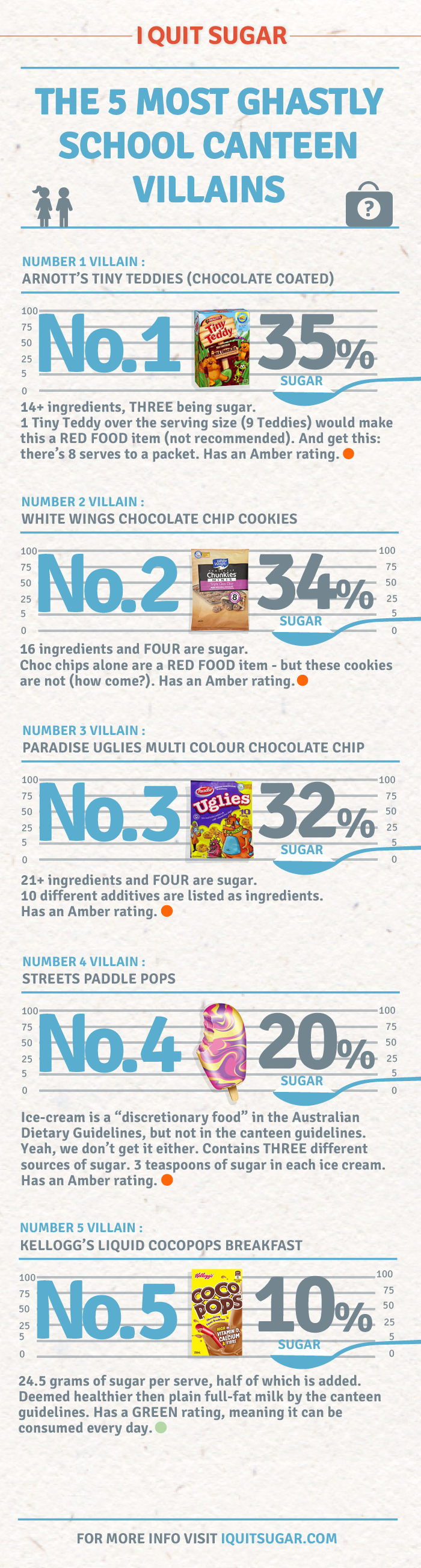
No wonder the waistlines of our kids are getting bigger.
But I can’t help but think that many parents are confused. They put food in the lunchboxes of their kids thinking they are giving them wholesome treats, but don’t realise that fancy packaging and 'trick words' like 'organic', 'wholesome' and 'natural' does not mean healthy and sugar free. They are usually sugar coated words to make a product appear healthier than it is. And they can get away with it because they are telling the truth, but concealing certain details. For example, "99% fat free" would mean that the fat has been taken out, but more sugar has been added. Take a look at this nutrition panel for a relatively 'healthy looking' museli bar.
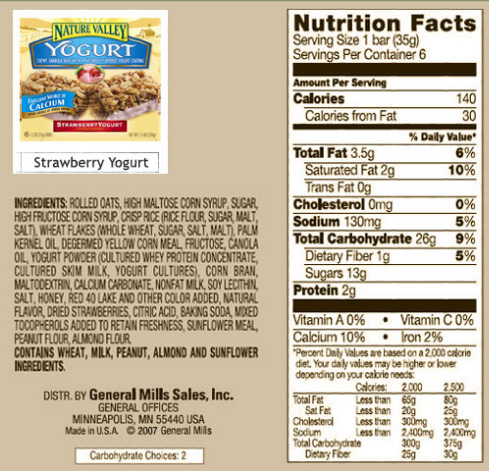
Firstly, there are a lot of clories in here for a 'small snack.' But above that, there are 13g of sugar in this product! That is 13g os the sweet stuff in a product that parents or their kids probably would not even count as a 'sugary treat.' Most would probably look at this and healthy and wholesome and encourage their kids to eat it.
Now have a look at this serving of chocolate. Around the same calorie count (I did the conversion), and about the same sugar content. But you would count the chocolate as unhealthy and the museli bar as healthy, right?
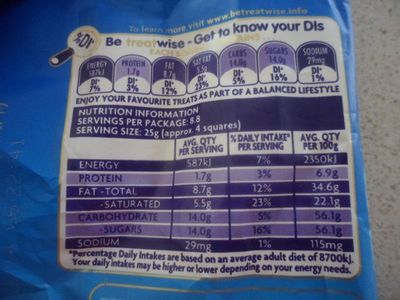
Do not worry, everyone falls for this fancy packaging and marketing. The best we can do is educate ourselves and make the most informed decisions for us and our kids.
But aren't there guidelines?
Australia has an agency called National Healthy School Canteens Project (NSHCP) which gives certain packaged foods the tick of approval. The scariest thing: Junkfood companies themselves decide if their product fits into these loose canteen guidelines. Argh!
In her blog titled ''The horrific truth behind school canteen approved snacks,'' Sarah takes a look into one of the biggest loopholes associated with the NSHCP: serving sizes.
The serving size of the Amber-rated ('select carefully') Tiny Teddies Half-Coated in Milk Chocolate is a measly 9 biscuits. If you had just 1 more Tiny Teddy, you’d be in the red zone. The Honey Tiny Teddies have 13 biscuits to a serve. We reckon Arnott’s are making their serving sizes inconsistent to fit their junk to the guidelines.
So what do we do to make our kids and the future of Australia healthier?
In countries where child obesity is far lower than that of ours, like Sweden and France, the government takes a lot of control and responsibility over what they feed their kids:
That is a pretty awesome concept. No wonder their child obesity rates are low.
But as Sarah and the team at I Quit Sugar uncovered, the country with the best track record is France.
Take a look at a typical French school canteen lunch
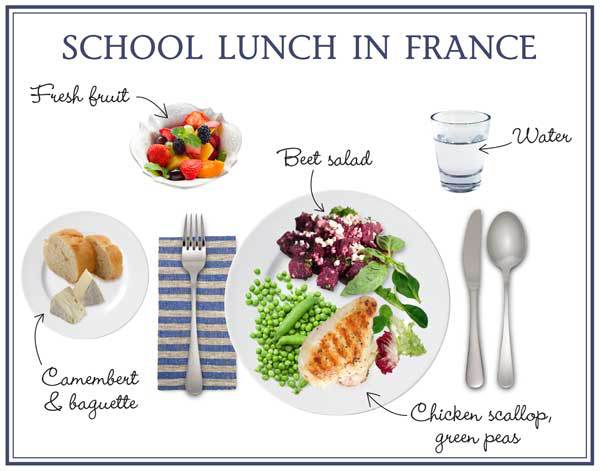
Looks pretty scrumptious if you ask me.
And one of the biggest and most amazing lunchtime secrets of a French school… the kids are served veggies first, so that they get full on them. Now why didn’t we think of that?
…
How does your kid’s school canteen stack up?
comments
Կոչ Հայութեան ու Հայրենիքի Իշխանութեան
Editorial:1918-2024. The Struggle for Independent, Sovereign Statehood Continues
Armenia Media Updates: 29 March 2023 Edition
Armenia Media Updates: 23 March 2023 Edition
#TogetherForSyria Telethon Raises over $110,000 for Armenians In Syria
10 August 2022: Week to Week by Armenia Media with Shahen Araboghlian
3 July 2022: Week to Week by Armenia Media with Shahen Araboghlian
17 June 2022: Week to Week by Armenia Media with Shahen Araboghlian