
By Asbarez | Wednesday, 16 June 2010
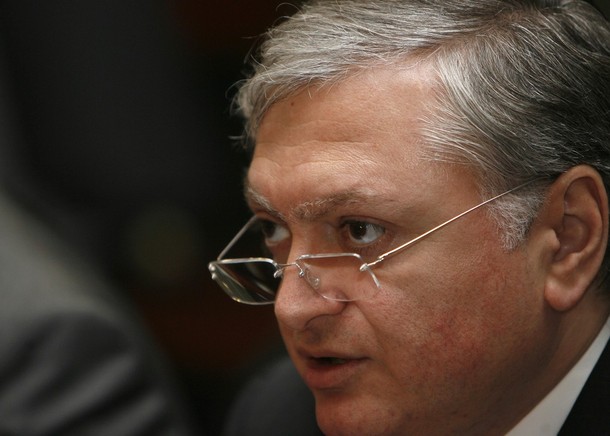
YEREVAN-Armenia's foreign minister, Eduard Nalbandian, said Turkey should step up and drop preconditions for normalisation of ties Armenia. Nalbandian told the Austrian journal, PROFILE, that in such an instance, Armenia would resume negotiations in the now-suspended Armenian-Protocols.
Below is the English translation of the interview:
PROFILE: Mr. Foreign Minister, the region here has been facing major changes during the last years: Iran is exerting more and more influence, Turkey is trying to establish itself as regional powerbroker, Armenia as a small country is caught in the middle: Do you worry for the future?
EDUARD NALBANDIAN: Armenia is not a small country. There is not only this small piece of land here in the region, but of hundreds of other Armenians all over the world - everywhere, Armenians live, their communities have created small Armenias which create a unity all over the world.
PROFILE: But still your direct neighbors are bigger and sometimes more aggressive countries.
E.N.: There were things to worry during our history. We strive for stability and security in our region, but it not only dependent on us. We are trying to have normal relations with all our neighbors and that's why we initiated the process of normalization with Turkey. We have good relations with Iran, we have good relations with Georgia and we are trying to settle the conflict between Nagorno-Karabakh and Azerbaijan in order to have normal relations with Azerbaijan as well.
PROFILE: At the moment the world is looking with concern on the nuclear program of Iran. Don't you consider this a threat to Armenia as well?
E.N.: We are following the developments of this issue carefully. We hope that Iran and the international community will come to a solution with joint efforts.
PROFILE: Recently it seemed that there had been a major breakthrough in the relationship between Armenia and Turkey - meanwhile, the rapprochement is stalled again. Do you see a chance for a new dynamic in the near future?
E.N.: The Armenian-Turkish relations were in a deadlock, when the President of Armenia Serzh Sarkisian invited his Turkish counterpart President Gul to Armenia. This visionary initiative, which was met with a positive response by the Turkish President, allowed us to start the process and after several months of difficult negotiations, we made a significant step toward normalization of the Armenian-Turkish relations by signing the two Protocols on the establishment of diplomatic relations, having the common border opened and development of bilateral relations, in Zurich last year.
PROFILE: Yet, the ratification has been suspended. Why?
E.N.: After the signing of the Protocols, Armenia began the ratification process having gone through several procedures, the decision of the Constitutional Court, a month in advance of the statutory deadline announcing that the Protocols conformed to the country's basic law. In early February the president of Armenia announced in his speech at Chatham House in London that the Armenian parliament, where the President enjoys comfortable majority, will ratify the Protocols as soon as Turkey does.
The Turkish side, having easier ratification procedures has taken practically no steps to that end, except for sending the Protocols to the Parliament, and has effectively blocked the ratification process for nine months now.
PROFILE: Do you see the rapprochement continuing the near future?
E.N.: The Armenian approach completely corresponds with the position of the international community: ratification and implementation of the agreements without preconditions and within a reasonable timeframe. With this common understanding we have started and conducted this process and came to the agreements. And in the protocols there are no preconditions.
We hope that the process is not dead, but suspended. And as it was said very clearly we will be ready to move forward if there is again a partner in Turkey ready to move forward with the normalization without any preconditions.
PROFILE: Turkey on its part claims that Armenia is blocking the rapprochement: Who is responsible then?
E.N.: Turkey is trying to find baseless reasons for protracting the process, independent of its logic. At what point Armenia blocked normalization? No one could point out. All the Armenian steps on normalization process were commended by the entire international community. Even the decision on the suspension of the ratification process was met by understanding and applause.
PROFILE: According to media reports, the most important reason for the suspension of the negotiations with Turkey is the conflict over Nagorno Karabakh. Does this mean that the rapprochement on the matter of the Genocide is already more advanced than on the issue of Nagorno Karabakh?
E.N.: The main and only reason for the suspension of the process is resumption of the Turkish attempt to link the normalization of relations with other issues. After the signing of the protocols, Turkey backtracked and started again to speak in the language of preconditions, for instance attempting to link the Armenian-Turkish normalization process to the Nagorno-Karabakh conflict resolution. Not only Armenia, but also the mediators-supporters of this process-the entier international community, have publicly made it clear that the Nagorno-Karabakh conflict resolution has no linkage to the Armenian-Turkish normalization process, and that such a linkage could damage both processes.
PROFILE: Has there also been domestic pressure for abandoning the negotiations?
E.N.: Discontent by many Armenians, not only in Armenia, but also in the Diaspora is motivated by the lack of confidence toward Turkey's good faith. And the reason for suspension is conditioned by the fact that Turkey today is unable to respect reached agreements, its commitments and given words.
PROFILE: For some time, Turkey seemed to be open for the normalization of the relations, but then it sharply changed its attitude. Do you have an explanation why [Turkish Prime Minister Recep Tayyip] Erdogan did that?
E.N.: I can't say that nobody knows why, but I can say that almost no one understands.
PROFILE: Turkey's Prime Minister Erdogan has threatened very clearly to expel 100,000 Armenians. Does this evoke remembrance of the death marches in the year 1915?
E.N.: These kinds of remarks by a Turkish leader speak for themselves. That means and it's regrettable that some leaders in modern Turkey haven't given up the discriminatory and racist approaches of the Ottoman period
Of course, this particular statement was a shock for everyone and not only in Armenia. The Armenian Genocide started with exactly such statements in 1914-1915. Later in the end of the 20th century massacres and deportations of the Armenian population of Azerbaijan were accompanied by such kind of racist statements.
PROFILE: Why is it so important for Armenia that Turkey accepts the word "genocide"?
E.N.: From the very beginning of this process we have told our Turkish counterparts that in no way Armenia will question the veracity of the Armenian Genocide or the importance of its international recognition.
We see the recognition and condemnation of the first Genocide in the twentieth century not only as a tribute to memory of its victims, but also as an important tool to prevent further genocides.
PROFILE: You are an optimist. Do you think future genocides will be prevented?
E.N.: You probably know, that Rafael Lemkin, the author of the term "Genocide" invoked the Armenian Genocide as a reason for his wording on the crime against humanity. Although it is very hard for us, we did not put the Armenian Genocide recognition by Turkey as a precondition for normalization of our relations. Turkey should reconcile with its own past to be able to build its future. Nelson Mandela once said. "True reconciliation does not consist in merely forgetting the past".
At the same time, I have to mention that inside Turkey there are certain processes and movements calling for Genocide recognition. Right after we initiated the normalization process, several Turkish intellectuals started an internet campaign, which was called "Apology campaign." In just few weeks 35.000 people signed that petition. For the first time in 95 years, this year on April 24, the Armenian Genocide was commemorated at Istanbul's Taksim square. I hope one day Turkey will recogize the Armenian Genocide. And that is important for Turkey itself. Many in Turkey are beginning to understand this and almost no one has any doubt about it outside of Turkey.
PROFILE: The fact that Turkey refuses to do so may be connected with fears of demands for compensation and even territorial claims: What does Armenia call for aside from acceptance of Turkey's liability for Genocide?
E.N.: Since its independence, Armenia has never made any statements on territorial claims. It is unfortunate that certain Turkish political forces are using such arguments in order to create fear in Turkish society.
PROFILE: And demands for financial reparation?
E.N.: This is a very hypothetical question. There are descendants of Armenians all over the world who lost their properties back then. They could have judicial avenues to proceed with their demands with or without recognition. This is very normal in a civilized and modern world. So where is the problem?
PROFILE: President Serzh Sarkisian told the German newsweekly "Der Spiegel," that a joint commission of historians would only make sense if Turkey would admit its guilt for the Genocide. Isn't this an unacceptable demand for a process intended to explore what exactly happened?
E.N.: The fact of the Armenian Genocide can not be questioned. We told this to our Turkish colleagues right at the very beginning of this process. We agreed to establish sub-commissions within an intergovernmental commission on the development of bilateral relations, and one of the sub-commissions has as its objective to restore confidence between two nations, but of course not at the expense of questioning the veracity of the Armenian Genocide. You couldn't reach the goal of restoring the confidence between nations by putting the Armenian Genocide under question.
PROFILE: Are you pleased by the fact, that four years ago the National Assembly of France has adopted a law that penalizes the renouncement of genocide against the Armenians? What is the sense of adopting such kind of laws in countries that have nothing to do with the genocide?
E.N.: It is the same as is the case of adoption of laws and bills on Holocaust by countries that have nothing to do with it. We still remember the chilling words of Hitler: "Go, kill without mercy. After all, who remembers the Armenians?"
Genocide is a crime against humanity. As such it concerns humanity as a whole, and not only the people who were its victim.
PROFILE: Germany still refuses to use the word "genocide" in its official description of the events of 1915, although it bears joint responsibility for the massacres by looking the other way and being dormant. What does Armenia expect of Germany?
E.N.: In the German Bundestag's resolution entitled "Commemorating the expulsion and massacre of the Armenians in 1915" adopted exactly five years ago, we can read the following: "The Bundestag deplores the disgraceful role played by the German Reich which, in spite of a wealth of information on the organized expulsion and annihilation of Armenians, made no attempt to intervene and stop these atrocities."
I believe that this wording speaks for itself. Every time the German leaders visit Yad Vashem Memorial and pay tribute to the victims of the Holocaust are gaining the sympathy and veneration of the world community for that gesture. Germany has reconciled with its own past and we hope that Germany will serve as an example to Turkey to accomplish the same.
comments
A Nation Betrayed, A Future to Reclaim: Why Unity is Our Only Path Forward at the 2026 Elections
Armenia Has Become Largest Buyer of Indian Weapons
ARF AU Statement: In solidarity with Tavush
OPED: The Beginning of a New Struggle
Already Scarce Bread to be Rationed in Artsakh Due to Blockade
Artsakh Political Factions Agree On New President
Pashinyan Warns International Community of New Azerbaijani Attacks Against Armenia, Artsakh
Artsakh Students, Kidnapped by Azerbaijan, Released into Armenian Custody
Artsakh Says Azerbaijan’s Demands Further Complicate Situation