
By ArmRadio | Wednesday, 23 June 2010
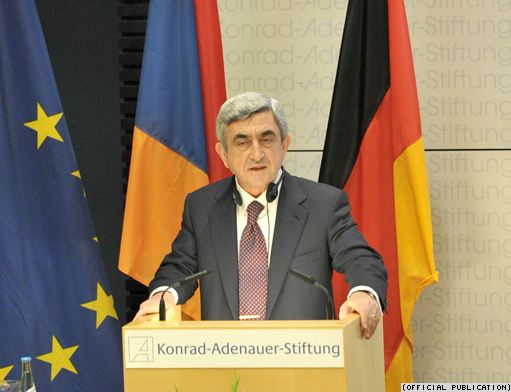 The strategic South Caucasus region will remain divided and its potential untapped as long as Turkey continues to impose its will on Armenia and refuses to act in accordance with the interests of the entire region, Armenian President Serzh Sarkisian said Wednesday.
Speaking at the Konrad Adenauer Foundation headquarters, a leading think tank in Berlin, Sarkisian said, Turkey’s so-called policy of “zero problems with neighbors, yields zero results” because Ankara does not work in coordination with its neighbor’s interests, but in collision.
“Turkey refused to fulfill its obligations by ratifying the protocols and resorted, again, to the language of threats and preconditions,” Sarkisian said. “Of course, the failure of the Armenian-Turkish normalization can be explained by the unwillingness of the Turkish political leadership and possibly Azerbaijan’s pressures.”
Many of the issues in the region are resolved in this way, through force, Sarkisian said. “The more powerful countries try to impose their own solutions.
The Armenian President went on to further outline what he said was necessary for a secure and prosperous future for his region.
He characterized the South Caucasus as a place where opposing realities exist, where peace and war, instability and security all exist because of an imbalance between the region’s neighboring countries.
“Our region has been called a bridge linking Asia to Europe, as an energy security link, as a factor of stability or instability, as a transit zone for communication routes, as a platform of competition or clash of interests,” Sarkisian said.
The end of the Cold War, he continued, brought stability to peace and stability to many countries throughout the word, but for the South Caucasus it ushered in a period of “severe conflicts” made worse by the uneven balance of power and relations in the region.
Azeri Attacks
Sarkisian also challenged the response by the OSCE Minsk Group and other international bodies to last week’s attack by Azerbaijan on Armenian forces in the Nagorno-Karabakh Republic, saying they failed to properly condemn Azerbaijan for inciting violence and violating the cease-fire.
“The entire world knows that it was Azerbaijan that violated the ceasefire in the contact line between the Azeri and Nagorno-Karabakh armed forces, on June 18,” said Sarkisian adding the international community’s unwillingness to single-out the responsible party disrupts the negotiations.
“We signed a trilateral ceasefire agreement in 1994 between Azerbaijan, Nagorno-Karabakh and Armenia. We did this at Azerbaijan’s suggestion and with Russia’s mediation. That is to say, we have a legal obligation not to violate the ceasefire, but ceasefire violations do occur. The incident, which occurred only hours after my meeting with Azerbaijan’s president, which took place with the mediation of the Russian president, was simply something unacceptable. It was a challenge to the Minsk Group, and Russia and to us, of course,” stressed Sarkisian.
Relations with Iran
Sarkisian also urged Western powers to respect Iran’s geopolitical interests in the South Caucasus and held up Armenia’s economic projects with the Islamic Republic as a model for regional cooperation.
In a speech at the Konrad Adenauer Foundation headquarters in Berlin, he said: “I do realize that in the light of the sanctions imposed on Iran some people will treat my approach with skepticism, but I am convinced that it is wrong and not possible to ignore Iran in regional solutions.”
“It is extremely important for the region to address Iran’s sense of being in danger. Without that, there can be no solution to future challenges or even the current [Iranian] nuclear problem,” he said.
The Armenian leader promoted his administration’s plans to implement more multimillion-dollar projects with Iran. He singled out the planned construction of an Armenian-Iranian railway and the unfolding upgrading of Armenia’s main highways stretching from the Iranian border to southern Georgia.
“These infrastructure projects could have a truly revolutionary significance in terms of transport communication as they would connect the Black Sea to the Persian Gulf and Indian Ocean,” he declared.
Sarkisian juxtaposed them against the pipelines carrying Azerbaijani oil and gas to international markets through Georgia and Turkey. He said the resulting windfall revenues have only enabled Azerbaijan to embark on a military build-up, thereby increasing the likelihood of renewed war in Nagorno-Karabakh.
“What has that project given the region?” he said, referring to the Baku-Tbilisi-Ceyhan oil pipeline. “Deepening of division lines, an arms race, an increase in bellicose rhetoric. Was this the anticipated ‘security and prosperity?’”
“Oil and gas pipelines, communication lines stretching only from the east to the west can not guarantee stability, security and prosperity in the region,” he added.
Sarkisian also denounced Azerbaijan for rejecting any economic cooperation with Armenia before a resolution of the Karabakh conflict. He said “economic integration processes” involving all regional states would greatly facilitate a Karabakh settlement.
comments
Armenian Piano Virtuoso Tigran Hamasyan Brings Manifeste to Sydney
Israel’s government unanimously voted on Sunday to formally recognize the Armenian Genocide.
A Nation Betrayed, A Future to Reclaim: Why Unity is Our Only Path Forward at the 2026 Elections
Armenia Has Become Largest Buyer of Indian Weapons
ARF AU Statement: In solidarity with Tavush
OPED: The Beginning of a New Struggle
Already Scarce Bread to be Rationed in Artsakh Due to Blockade