
By Asbarez | Monday, 09 August 2010
BY ADRINE AVANESYAN
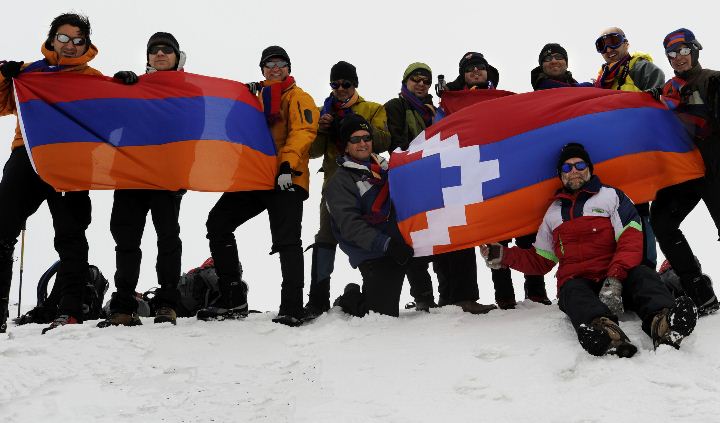
On July 15, a team of 11 men, including six from Southern California, two from New Jersey, two from Canada, and one from Fresno reached the summit of Mt. Ararat. Team "Ararat 11," a code name that the team had given themselves would soon be known to all Armenians.
On July 13, team "Ararat 11" traveled 14 hours in a van to Georgia in order to enter Turkey. At the Turkish border, one of the Turkish guards asked them why they were going to Turkey. A team member, who was fluent in Turkish, told the guard that they were going to climb Mt. Ararat. The guard took one look at one of the team member's white hair and asked, "This guy is going to climb Mt. Ararat?" The guy that the guard was referring to was Vatche Soghomonian of Fresno. The guard got up from his chair and requested a photo with Soghomonian. According to Soghomonian, the guards at the Turkish border were overall very cordial.
The team crossed the border into Dogubayazit, Turkey, a town at an elevation of 6,000 feet and situated on the base of Mt. Ararat. Team "Ararat 11" started their climb on July 15, 2010 and on day one they reached camp one at 10,000 feet. On day two they climbed to camp two at 14,000 feet where they spent the night.
That night there was heavy snow and hail "from hell," Soghomonian recollected Even though their guide refused to continue the climb, the team was determined to reach the summit of Mt. Ararat. When one of the team members, Seth Setrakian got altitude sickness, he was told by Dr. Khodam Rostamian, a doctor from Glendale Kaiser that was with the team that he should descend to a safe area and wait for the team there. Setrakian answered that if one was going to die, the best place for an Armenian to die was on Mt. Ararat.
Determined and their will power in tact, the team finally reached the summit of Mt. Ararat on day three where they erected the Armenian national and the Nagorno Karabakh Republic flags. The team sang and danced and "One had to be there to see the feeling of each individual. We were in heaven that day, "said Vatche Soghomonian
Each of the individuals in team "Ararat 11" had a different reason for taking on this mission. For many of the team members, they wanted to satisfy their dream that Ararat was once theirs.
For Noel Gharibian, there is no other symbol that is more important to Armenians than Mt. Ararat. Last September, Noel Gharibian had met with a group that had summated Mt. Ararat on September1. The group told him and others that were interested, how they had accomplished the climb and gave them the contact information for the Turkish organization that was responsible for arranging the climb. Although the team got the proper permits needed for the climb, once they got there they were told that the Ministry of Tourism had sent a fax saying that they had cancelled the permits.
However, the area is populated mostly by Kurds who don't care much for the Turkish central government and do not pay that much attention to permits. Gharibian stated that for the Kurds it was more about business and actually getting people up on the mountain. Thus, the team was able to go on with the climb.
For Edwin Davidian the experience was a once in a lifetime. "There are no words that can describe the feeling we experienced when we got to the summit," said Davidian.
He said this experience would be great teaching tool for his children and future generations to continue the kinship with homeland as represented by Mount Ararat.
For Vatche Soghomonian, it was about raising money for Armenia's Cosmic Ray Research Division (CRD) The CRD is a division of the Yerevan Physics Institute in Armenia. The Cosmic Ray Research Division is among the top 5 countries in the world with its knowledge of cosmic ray research and is able to predict bad weather ahead of time. Soghomonian believes that the CRD is doing important research that will help Armenia get further ahead in scientific advancement Since the CRD no longer receives aid from the Armenian government they rely mostly on individual donors.
Although this was Soghomonian's first time climbing Mt. Ararat, he is no stranger to using sports as a means of fundraising. His fundraising days go all the way back to his recruitment into the Armenian Technology Group (ATG) whose mission is to guide Armenia towards autonomy in the areas of food and agriculture. During his time with the ATG, Soghomonian participated in several bike-a-thons in order to raise money for various funds. ATG's first bike-a-thon, which took place in 1999, raised enough money to put the first grape vine nursery in Nagorno Karabakh.
For the Armenian Technology Group's 11th bike-a-thon, a friend of Soghomonian suggested that since Mt. Ararat was a huge symbol of Armenia, they should do a bike-a-thon in Armenian and then climb Mt. Ararat. Soghomonian talked about everyone's enthusiasm at the prospect of climbing Mt. Ararat.
Soghomonian wants Asbarez readers to know that that he is very much devoted as a Diaspora Armenian and will do whatever is in his means to find any possible vehicle to generate wealth to support his ancestral homeland. Raising money through bike-a-thons and climbing Mt. Ararat are such "vehicles" for Soghomonian.
comments
Armenian Piano Virtuoso Tigran Hamasyan Brings Manifeste to Sydney
Israel’s government unanimously voted on Sunday to formally recognize the Armenian Genocide.
A Nation Betrayed, A Future to Reclaim: Why Unity is Our Only Path Forward at the 2026 Elections
Armenia Has Become Largest Buyer of Indian Weapons
ARF AU Statement: In solidarity with Tavush
OPED: The Beginning of a New Struggle
Already Scarce Bread to be Rationed in Artsakh Due to Blockade