
By Civilnet | Friday, 11 April 2014
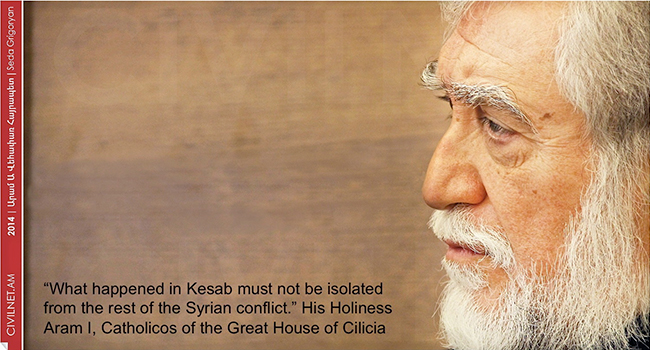
What happened in Kesab must not be isolated from the rest of the Syrian conflict. This was the message His Holiness Aram I, Catholicos of the Great House of Cilicia, repeated during a meeting with CivilNet in Antelias, Lebanon on April 8. The Catholicos stressed that the crisis in Kesab is part of the broader conflict that has torn Syria apart.
The Catholicosate has been actively supporting and extending assistance to the Armenians of Syria who have been caught up in the three-year-old civil war that has claimed almost 150,000 lives and left millions displaced. According to the United Nations, anywhere from one to two million Syrians have fled to Lebanon alone.
His Holiness said that the Armenians in Syria are an integral and inseparable part of Syrian society, therefore they are very much concerned about what is happening in Syria. “As a community, we should not associate ourselves with any given regime, political ideology or person, they are provisional…we remain attached to the supreme interests of Syria,” His Holiness said.
The Catholicos underscored that Syria has been an adopted homeland for Armenians following the days immediately following the Armenian Genocide. He said, “Syrian Christians and Muslims have accepted us as part of their society, they shared with us their homeland, and we became an inseparable part of Syrian society and in the last decades after the Genocide, we actively participated in the building and rebuilding of Syrian society.” The Armenian communities in Aleppo, Damascus, Khamishli, Der Zor and Kesab played a pivotal role in the progress of Syrian society in all spheres and all levels of society. He said that for that hospitality, the Armenians remain grateful to Syria.
“We believe that the Syrian conflict must be solved through a political process; the conflict must be ‘Syrianized’ and also the process aimed at the solution of this conflict must be Syrianized,” said Aram I and said that to ensure this process moves forward, the government, the opposition, civil society actors and community leaders must actively participate with the full support of the UN, the Arab League and the international community.
What can or should the Armenians of Syria do in a war over which they have no control? “We, as Armenians are ready to engage in dialogue and collaboration and relations with all trends of Islam, provided that they respect and accept Christian values and traditions and rights, that they put aside all forms of violence, and together with the Christians take part in the peacebuilding process of Syria,” emphasized the Catholicos.
The Catholicos said that Christians and Muslims have lived together for centuries and this has been and should remain a significant feature of Syrian society. “Syria belongs to both Muslims and Christians, including the Armenians, “ he said, adding that the Armenians are not newcomers, they are deeply rooted in the history, culture, traditions and culture of Syria. The richness and diversity of values, traditions and perspectives that co-exist in Syria should be a source of enrichment, enabling the Syrian people to live together with mutual respect and understanding, instead of a source of conflict or hatred.
The historic town of Kesab, which was attacked by Al Qaeda-backed rebels in the early morning hours of March 21, forcing the mass evacuation of its Armenian population, must be viewed in this context and not isolated from the Syrian conflict itself.
Kesab’s strategic and military significance, and the geopolitical interests at play, lend specificity and crucial importance to the Kesab region and not only for the Armenians. “For Armenians, it is very emotional still,” said the Catholicos. Memories of displacement and deportation, images of Armenians huddled in church courtyards have played a crucial role in the global Armenian reaction to the crisis in Kesab. “One only has to study the history of the region, the Syrian- Turkish relationship during the two world wars, the Sanjak of Alexandretta…and the strategic position of Kesab and Latakia to understand the complexity of the situation.”
The symbolism of the Armenians of Kesab being sheltered in Latakia has struck a very sensitive chord in the collective Armenian psyche and the Catholicos noted, “They are refugees for the third time in recent memory.”
Amidst the confluence of geopolitical interests and in the chaos of war, His Holiness — the one often called upon by foreign governments to speak for the Armenian communities in his care — was very clear: “We now have a situation where an entire Armenian town is being depopulated; we have to be realistic, our approach has to be down-to-earth and we should not be emotional. Armenia and the Diaspora must pursue this matter on the diplomatic and political level, in the United Nations and through other international organizations and agencies.” The Catholicos also said that he has suggested that Kesab be deemed a demilitarized zone and has spoken with officials at the UN in this regard.
The Catholicos’ approach was simple, pragmatic and yet filled with much urgency: “We have to work together to help the refugees who continue to remain in Latakia.” As he said it, he knew he was sounding a call to assist the hundreds of families who are suspended between the desire to return to their ancestral homes and the harsh reality of effectively being homeless.
comments
Armenian Piano Virtuoso Tigran Hamasyan Brings Manifeste to Sydney
Israel’s government unanimously voted on Sunday to formally recognize the Armenian Genocide.
A Nation Betrayed, A Future to Reclaim: Why Unity is Our Only Path Forward at the 2026 Elections
Armenia Has Become Largest Buyer of Indian Weapons
ARF AU Statement: In solidarity with Tavush
OPED: The Beginning of a New Struggle
Already Scarce Bread to be Rationed in Artsakh Due to Blockade