
By Hurriyet | Monday, 22 February 2010
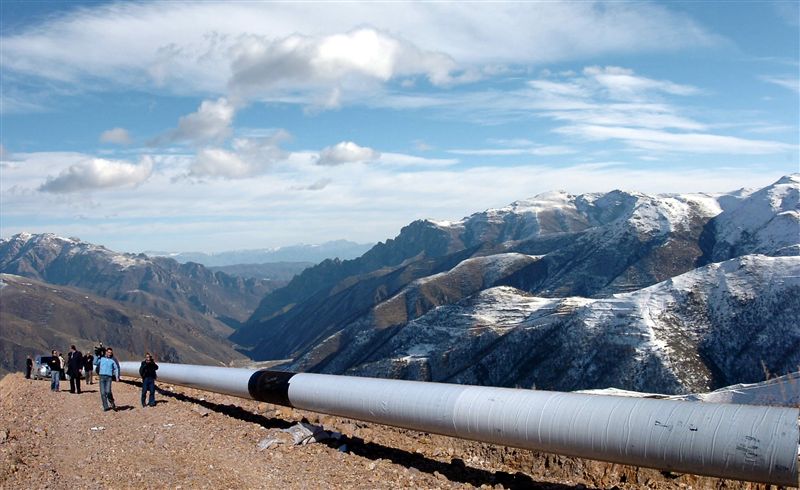
ANKARA (Hurriyet)-The European Union's special representative to Central Asia on Friday said he expected to see Armenia becoming a route for a future energy pipeline if Yerevan and Ankara quickly move to normalize relations and open their sealed border.
"There have been different options. Things have not been fixed up to now. The greatest idea to say is well, in the future, why not use Armenia as a way for other pipelines," Pierre Morel told the Turkish Hurriyet Daily in an interview.
Morel said he saw many options for new Caspian-Turkish energy pipelines due to the "mobile energy landscape" and predicted that Armenia could be the site of a future network.
"There have been different ideas about the energy routes. The southern corridor is not just Nabucco, but a wider concept," he said. "It is also about transportation. We have to move transportation to the Caucasus."
The Nabucco pipeline is an EU-led and US-backed project aimed at transporting Middle Eastern and Caspian gas through Turkey to Europe in an effort to break the Russian monopoly over regional energy supplies.
"But once again look at what the other corridors are," Morel said. "A corridor is not one pipeline. A corridor is a system of pipelines. For sure, when the southern corridor takes shape, you'll have a system of pipelines."
Morel said, "Nabucco is going through a good phase and has been moving through important steps" following the signing of an inter-governmental agreement in Ankara last summer.
"Many said Nabucco was a dream ... [But] this was done and Turkey played an important role. We're coming step-by-step toward concretization," he said.
One of the major obstacles for Nabucco is a lack of gas earmarked for transit. Morel said northern Iraq could be a potential source while emphasizing hesitations over Iranian gas.
"We have had more discussions today about northern Iraq as a potential source of gas for Nabucco. [Meanwhile,] there are question marks connected with Iran, not only political questions, but the context of the Iranian energy policy, which has been rather specific," he said.
Morel held discussions at parliament as well as the foreign and prime ministries regarding Caspian energy, the southern corridor, Central Asian developments and the Turkish-Russian relationship.
Commenting on Azerbaijan's energy policy, Morel said it had become clear the country was trying to keep its options open.
Baku signed a deal with Russian energy giant Gazprom last year to transfer 500 million cubic meters of gas to Europe in the first phase of the Shah Deniz gas field. The agreement, which followed the normalization process between Turkey and Armenia, was regarded as an ultimatum to Ankara and a blow to the Nabucco plan.
"[Azerbaijan] is sending signals to their different partners," Morel said, adding that the country is also trying to send signals to Turkey, the EU and Russia. "The 500-cubic-meter agreement they signed with Russia is specific, not long-term. It is for one time, but it is also a signal."
He said all the major European energy companies presently operating in Azerbaijan were following the developments "very closely."
comments
Armenian Piano Virtuoso Tigran Hamasyan Brings Manifeste to Sydney
Israel’s government unanimously voted on Sunday to formally recognize the Armenian Genocide.
A Nation Betrayed, A Future to Reclaim: Why Unity is Our Only Path Forward at the 2026 Elections
Armenia Has Become Largest Buyer of Indian Weapons
ARF AU Statement: In solidarity with Tavush
OPED: The Beginning of a New Struggle
Already Scarce Bread to be Rationed in Artsakh Due to Blockade