
By RFE/RL | Thursday, 01 October 2009
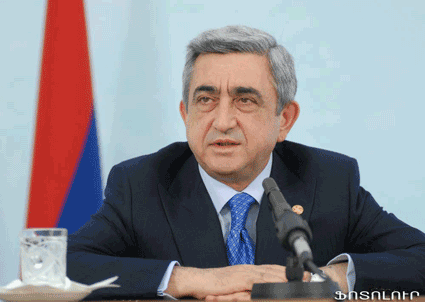
YEREVAN (RFE/RL)-President Serzh Sargsyan tried to defended his policy of rapprochement with Turkey on Wednesday, insisting that it will not thwart greater international recognition of the Armenian genocide or result in more Armenian concessions in the Nagorno-Karabakh conflict.
In his most in-depth public speech on the charged subject delivered to date, SargsyanSargsyan portrayed the fence-mending agreements finalized by Ankara and Yerevan as a "realistic" compromise necessary for Armenia.
"This is nether an agreement on our capitulation to Turkey, nor a big treaty on strategic partnership to cause concern. And if somebody thinks that these documents should contain only our desires and lead to the realization of only our aspirations, they need to be a little realistic and understand that that's not possible," he told members of the presidential Public Council, a body comprising 36 pro-establishment politicians and public figures.
Sargsyan again acknowledged that the two Turkish-Armenian draft protocols envisaging the normalization of bilateral relations carry potential risks for the Armenian side. "But when did we not have [concerns?]" he asked. "When we were voting for Armenia's independence [in 1991,] were all of us 100 percent certain that everything will go smoothly? I personally had a lot of concerns and anguish when we were forced to mount an armed struggle [against Azerbaijan] in Nagorno-Karabakh."
"If we are unable or unprepared to hold negotiations with the Turks, why did we become independent in the first place?" he added. "We could have left our status unchanged and let others continue to determine our policy in our place."
The president addressed the Public Council at the end of a nearly three-hour meeting that wrapped up its discussions on his conciliatory policy on Turkey. The head of the consultative body, Vazgen Manukian, said it overwhelmingly voted for a resolution that recommended the protocols' ratification by the Armenian parliament. "We discussed all the pluses and minuses, drew a line, added up things, and got a plus," Manukian told the meeting.
Still, several members of the council voiced reservations about some provisions of the deal which is expected to be signed on October 10. Among them were Hayk Demoyan, director of the Museum-Institute of the Armenian Genocide, and Ruben Safrastian, director of the Institute of Oriental Studies at the Armenian National Academy of Sciences.
The two historians were specifically worried about the planned formation of a Turkish-Armenian "sub-commission" that would investigate the veracity of the Armenian Genocide. They asked Sargsyan to comment on concerns that Ankara could exploit the existence of such a body to keep more countries from recognizing the massacres as genocide.
"It's obvious that if that process [of genocide recognition] slows or, in which I don't believe, is suspended, it will be the fault of not our initiative but those people who want to use the initiative as an excuse for not dealing with that matter," replied Sargsyan.
He also argued that both sides will be equally represented in the controversial panel and that the Turks will not be able to determine its agenda single-handedly. "No sensible Armenian can forget the genocide," he said.
Sargsyan also rounded on critics for condemning another protocol clause which commits Armenia to explicitly recognizing its existing border with Turkey defined by the 1921 Treaty of Kars. "The Soviet Union recognized the Treaty of Kars for five times, and when we joined the Commonwealth of Independent States [in 1991] ... we pledged to comply with all agreements signed by the Soviet Union," he said. He insisted at the same time that neither protocol obligates Yerevan to recognize the 1921 document.
The Armenian leader further dismissed as "ludicrous" his detractors' claims that Turkey agreed to make peace with Armenia only in return for additional concessions to Azerbaijan allegedly promised by him. He indicated that his administration's position on the Karabakh conflict is not different from his predecessor Robert Kocharian's policy.
"If we don't see such a solution [acceptable to the Armenian side] nothing can force us to accept it," he said. "In that case, the entire nation would have to rally and say that we are ready to fight and go to war."
comments
Armenian Piano Virtuoso Tigran Hamasyan Brings Manifeste to Sydney
Israel’s government unanimously voted on Sunday to formally recognize the Armenian Genocide.
A Nation Betrayed, A Future to Reclaim: Why Unity is Our Only Path Forward at the 2026 Elections
Armenia Has Become Largest Buyer of Indian Weapons
ARF AU Statement: In solidarity with Tavush
OPED: The Beginning of a New Struggle
Already Scarce Bread to be Rationed in Artsakh Due to Blockade