
By Asbarez | Thursday, 07 April 2022
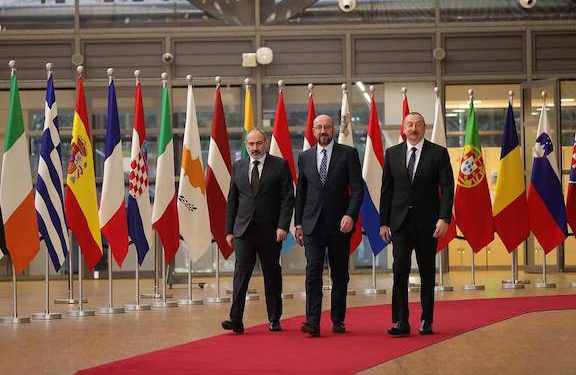
Prime Minister Nikol Pashinyan and President Ilham Aliyev of Azerbaijan walked away from their more than four-hour meeting on Wednesday in Brussels having agreed to start the process of drafting a “peace treaty” and set up a commission to advance the issue of demarcation and delimitation of borders between the two countries. Reportedly, there were disagreements, however, on the process of opening the transport links.
The meeting, which was mediated by the President of the European Council Charles Michel, was unable to address the issue of Azerbaijan’s incursion into Armenian villages in Artsakh’s Askeran region.
Pashinyan said at a cabinet meeting on Thursday that deterioration of Artsakh’s security was discussed during the meeting—specifically Azerbaijan’s incursion into Parukh and advancement of its forces to the Karaglukh Heights—however the discussion did not seem to “lead to a common assessment of the situation.”
“I myself didn’t find the further discussion of this topic to be appropriate at the platform in Brussels,” said Pashinyan, who said that the matter related to the “Azerbaijani military invasion into the area of responsibility of the Russian peacekeeping contingent in Nagorno-Karabakh and this issue should be discussed with the participation of our Russian colleagues.”
Pashinyan, who discussed the matter last week in two phone calls with President Vladimir Putin of Russia, called for the immediate withdrawal of Azerbaijani forces from the areas in which they have advanced.
“Therefore we expect that the Russian peacekeepers in Nagorno Karabakh will take steps to ensure the withdrawal of the Azerbaijani military units from their zone of responsibility,” said Pashinyan.
“We also attach importance to holding an investigation into the adequateness or potential inaction of the Russian peacekeeping troops’ actions during the course of development of the events and in the theater of operations,” Pashinyan reiterated. This matter was brought up earlier this week by opposition lawmakers and reporters during a discussion with deputy defense minister Arman Sargsyan, who evaded the question, saying that it was a “sensitive topic.”
“We have decided all together to launch a concrete process, to prepare a possible peace treaty and to address all necessary elements for such a treaty,” Michel told reporters on Wednesday night after the Pashinyan-Aliyev meeting, reported Azatutyun.am.
“I am confident that tonight we took an important step in the right direction,” he said. “It doesn’t mean everything is solved. But it means that we made progress.”
Michel issued a written statement following the meeting, in which he noted that “both President Aliyev’s and Prime Minister Pashinyan’s stated desire to move rapidly towards a peace agreement between their countries. To this end, it was agreed to instruct Ministers of Foreign Affairs to work on the preparation of a future peace treaty, which would address all necessary issues.”
Speaking at Thursday’s cabinet meeting, Pashinyan reiterated the position that Yerevan has found nothing unacceptable in Azerbaijan’s proposals, which include a call for recognizing the territorial integrity of Azerbaijan, which some circles have said includes Artsakh as part of Azerbaijan.
The government and people of Artsakh, meanwhile, have unequivocally rejected any status that will have Artsakh become part of Azerbaijan.
“However, they do not complete the matters of the peace agenda. And for us, the security guarantees of the people of Nagorno Karabakh, the protection of their rights and freedoms, as well as the clarification of the final status of Nagorno Karabakh are of principled importance. These issues are involved in our responses relating to the peace agenda and must become a subject of negotiations,” said Pashinyan.
Without going into details on Thursday, Pashinyan told his cabinet ministers that there were disagreements about the opening of the transport links between Armenia and Azerbaijan during his meeting with Aliyev.
Aliyev has long pushed for the so-called “Zangezur Corridor,” a scheme that would see a road connecting Azerbaijan proper with Nakhichevan through Armenia. Yerevan, on numerous occasions, has opposed such a link and has insisted, along with Russia, that the opening of transportation links must respect the territorial integrity of the country through which the roads or railways pass.
comments
Israel’s government unanimously voted on Sunday to formally recognize the Armenian Genocide.
A Nation Betrayed, A Future to Reclaim: Why Unity is Our Only Path Forward at the 2026 Elections
Armenia Has Become Largest Buyer of Indian Weapons
ARF AU Statement: In solidarity with Tavush
OPED: The Beginning of a New Struggle
Already Scarce Bread to be Rationed in Artsakh Due to Blockade
Artsakh Political Factions Agree On New President
Pashinyan Warns International Community of New Azerbaijani Attacks Against Armenia, Artsakh
Artsakh Students, Kidnapped by Azerbaijan, Released into Armenian Custody