
By Asbarez | Friday, 12 February 2010
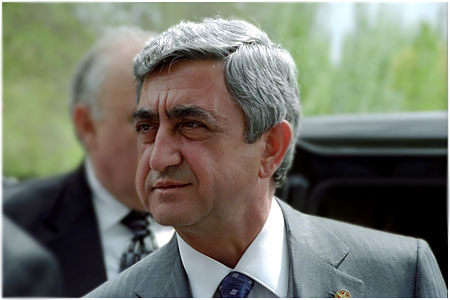
LONDON-Armenian President Serzh Sargsyan, in a speech at the renowned Chatham House, said that he would send the protocols for ratification to Armenia's parliament, adding that the Turkish parliament should ratify them first.
"After this meeting at Chatham House I intend to instruct my personnel to send these documents to Armenia's National Assembly for starting the ratification process," said Sargsyan during his speech, which was part of his official visit to the United Kingdom.
During a press briefing following his remarks, Sargsyan said that he expected the Turkish parliament to ratify the documents before Armenia moves forward.
"The parliament of Armenia will vote on the protocols if the Turkish parliament goes ahead with that," he said, reported the Thomson-Reuters news agency. "Otherwise we can find ourselves in a situation where the Armenian parliament ratifies and the Turkish parliament fails to."
PRESIDENT'S SPEECH
Values and Security in the South Caucasus
In outlining Armenia's commitment to the protocols process, Sargsyan reiterated his commitment to normalization by saying, "We have agreed to move forward without any pre-conditions, not making our relations contingent upon Turkey's recognition of the Armenian Genocide."
"However, if, as many suspect, it is proven that Turkey's goal is to protract rather than to normalize relations, we will have to discontinue this process," he asserted.
"I reaffirm that as the political leader of the parliamentary majority, I exclude a failure by Armenia's parliament to ratify the protocols in case of their ratification by Turkey without preconditions in accordance with our understandings," he said.
During the post-speech briefing, Sargsyan also commented on Turkey's continued contention with a ruling last month of Armenia's Constitutional Court, which paved the way for Sargsyan to submit the documents to parliament.
"It's only the Turks that are trying to find something in it," said Sargsyan, reported RFE/RL. "Nobody else, no other involved party, sees anything strange in that decision."
Armenia's high court ruled that the protocols were in line with Armenia's constitution, adding the Turkey-Armenia normalization process should not be linked with the Nagorno-Karabakh conflict resolution process-a widely articulated pre-condition by official Ankara-and that based on Armenia's Declaration of Independence, Yerevan would not be deterred in pursuing international recognition of the Armenian Genocide.
"Would the Turks have been happy if our Constitutional Court had ruled that these protocols do not conform to Armenia's constitution?" he said. "Maybe they would have been happy, seeing as they are trying to use every opportunity to torpedo the process."
"I can't understand why the Turks ... attach so much importance to the Constitutional Court's decision. It's an integral part of our domestic decision-making process," added Sargsyan.
"Did we say in those protocols that the Republic of Armenia calls into question the genocide?" emphasized Sargsyan. "Did we ever say during the negotiations that we are going to hamper the process of international recognition of the genocide? If the Turks think we did, it's not our fault."
To demonstrate his administration's commitment to regional stability and peace, Sargsyan told the audience at the Chatham House British Institute of International Affairs that he would invite his Azeri counterpart, Ilham Aliyev, to the "potential opening ceremony of the Turkish-Armenian border."
Karabakh Was Never Part of Azerbaijan
In one of the most assertive discussions on the Karabakh conflict, Sargsyan told the Chatham House gathering that Karabakh was never part of Azerbaijan, and ruled out any "pressure-driven concessions" in the Karabakh process that could threaten the security and physical existence of the people of Karabakh.
"The truth is that Karabakh was never a part of independent Azerbaijan. It was forced into Azerbaijan by a decision of the Soviet Union party authority, which, defiant of the League of Nations decision and the popular referendum as a means of determining the border between Armenia and Azerbaijan, decided in its Caucasus Bureau session in 1921, under Stalin's direct pressure, and in violation of the procedure, to annex Mountainous Karabakh on the condition of forming a national autonomy on these Armenian territories within the Soviet Socialist Republic of Azerbaijan," explained Sargsyan.
The Armenian president also outlined the many instances of Soviet Azeri attempts to depopulate Karabakh of its Armenian residents and the vehement resistance by the Armenian population, which continuously rejected the Soviet model of its existence.
Sargsyan cautioned about taking out of context public declarations about Karabakh, saying that the Karabakh conflict was multi-dimensional in scope.
"The problem can only be resolved in the context of the international law principles of the self-determination of nations, territorial integrity, and the non-use of force. All the stakeholders now realize this truth. Whenever one refers to the Mountainous Karabakh conflict, the notion of territorial integrity should not be emphatically underlined, especially that even if that notion is perceived to be the only one applying in the case of the Mountainous Karabakh conflict, it would not lead to its application in the form envisioned by Azerbaijan," explained Sargsyan.
"I would like to pose a rhetorical question to all who consider themselves advocates of territorial integrity. Where were they when the Soviet Union collapsed and the borders changed? Where were they when Yugoslavia was falling apart? Why do you think that Azerbaijan could secede from the USSR, but Mountainous Karabakh could not? Why do you think that large empires should disintegrate, but small ones should persevere? What is the basis? Instability? I cannot perceive it. I do not accept it. Because unfair decisions are the very cause of instability," added the president.
Sargsyan warned that Azerbaijan was continuing its "war rhetoric" and its stockpiling of weapons and urged Western powers that are spending billions on Azeri oil to be vigilant, saying "they cannot remain indifferent to how their moneys are being spent."
"The fact is that these very proceeds can become a source of threats, something that has happened elsewhere in the past," cautioned Sargsyan.
"Armenia and Karabakh have never unleashed and never will unleash a war. We despise war, as our generation was forced to look death straight in the eyes, and has seen and lost more than can be imagined," said Sargsyan.
"However, we realize that we must be ready for war in case others wish to fight. We cannot turn a blind eye to recurrent belligerent threats coming from a neighboring state, whose President's New Year address to his people sounded no different from the speech of an army commander motivating his units for a battle. The war rhetoric is intensifying in the Caucasus. Armenia predominantly refrains from responding to the threats. Quoting John Kennedy: ‘we do not need to utter threats to prove that we are firm. However, it does not solve the problem. Threats also amount to violence, and violence usually begets violence,'" explained Sargsyan.
"Our belief is that the settlement of the Karabakh conflict should be based on human rights and the will of the Karabakh people as an expression of their collective identity. It is the only way to achieve lasting, feasible, and peaceful settlement. The alternative to this settlement is the forcing of the Karabakh people back into Azerbaijan, which will inevitably lead to attempts of new ethnic cleansing of Armenians in Karabakh. There is no alternative here, especially given that Azerbaijan has labeled the vast majority of the Karabakh population as "criminals" over the last two decades. Hence, in view of the consequences of this alternative, we clearly rule out any pressure-driven concessions in the Karabakh process that would threaten the Artsakh people's physical existence, security, and right to live in dignity," countered Sargsyan.
comments
A Nation Betrayed, A Future to Reclaim: Why Unity is Our Only Path Forward at the 2026 Elections
Armenia Has Become Largest Buyer of Indian Weapons
ARF AU Statement: In solidarity with Tavush
OPED: The Beginning of a New Struggle
Already Scarce Bread to be Rationed in Artsakh Due to Blockade
Artsakh Political Factions Agree On New President
Pashinyan Warns International Community of New Azerbaijani Attacks Against Armenia, Artsakh
Artsakh Students, Kidnapped by Azerbaijan, Released into Armenian Custody
Artsakh Says Azerbaijan’s Demands Further Complicate Situation