
By Armenian Weekly | Monday, 10 May 2010
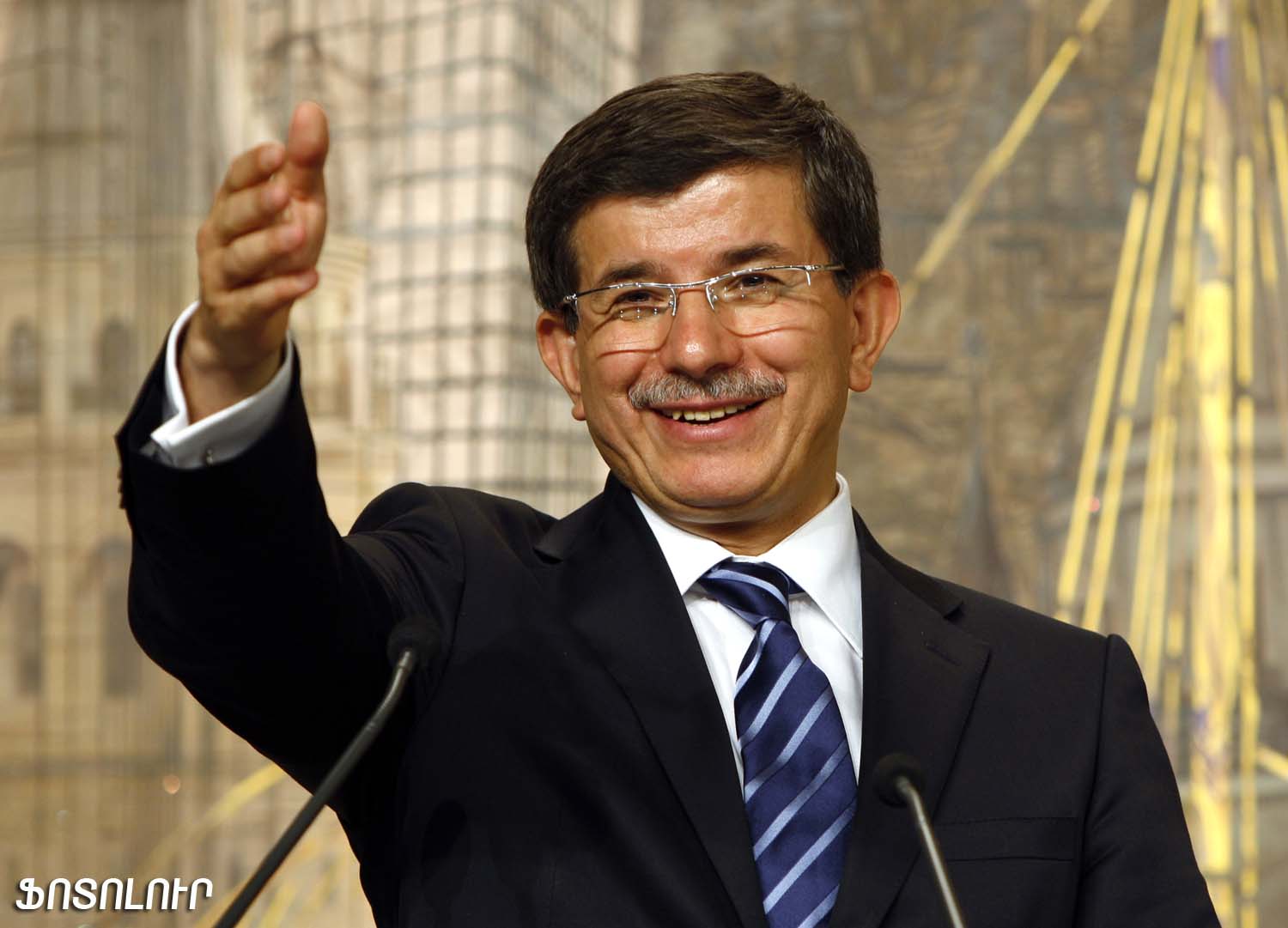
An article titled "The Protocols Live" by conservative columnist Taha Akyol in the May 6, 2010, issue of Milliyet, recounts a conversation with Turkish Foreign Minister Ahmet Davutoglu on a flight to Kiev. In the conversation, Davutoglu suggests that the protocols with Armenia are not dead and that some "quiet diplomacy" is under way. The article also comments on the "overture" to Turkish-Armenians abroad. Below is a translation of the article, which also sheds some light on the background of the protocols and Turkey's ties with Azerbaijan.
The Weekly thanks Ara Arabyan for the translation.
***
We are flying to the Ukrainian capital, Kiev, with Foreign Minister Ahmet Davutoglu. Tomorrow, we will go to Crimea, the homeland of the great Ismail Gaspirali [late 19th-century Tatar newspaper publisher and politician]. On the flight, I ask Davutoglu if the protocols [with Armenia] are dead. He replies "no."
Have they been frozen?
"You can say that. It depends on how you look at it. If you analyze the process, our relations with Armenia are better than they were one year ago. Our relations with Azerbaijan are also better. This means that the river is not frozen; it is flowing."
There is apparently a tacit "three-way accord." Ankara, Baku, and Yerevan will evidently conduct quiet diplmacy for "a few months; they will not issue any statements that may make waves in public opinion.
What then? Then "positive steps" will be taken with regard to both the protocols and the problems of the Caucasus.
Why Not in Protocols
I ask: "Did you really sit at the negotiating table with Armenia without any mention of the Karabakh problem?"
Davutoglu recounts a conversation he once had with Republican People's Party [Deputy General Chairman] Onur Oymen. Davutoglu apparently asked Oymen: "You worked at the Turkish Foreign Ministry for many years. Do you believe that our foreign ministry would sit at the negotiating table without mentioning Karabakh or the 1915 events?"
Oymen reportedly replied "no."
I get a sense that both the Armenian occupation [of Nagorno-Karabakh] and the history issue were discussed during the talks in Switzerland and that, furthermore, these discussions went into the records of the talks.
So, why were they not included in the protocols?
After some comments on condition that they "not be published," Davutoglu recalls the concept of "constructive ambiguity" in diplomacy. The purpose of "ambiguity" in the text [of the protocols] was to ensure that the process would get rolling; progress would be made in steps later.
Indeed, as I wrote several times in the past, the protocols include general principles that can provide guidance on both the Karabakh problem and the history dispute.
‘We Managed April 24 Well'
Azerbaijan was concerned that Turkey might have sold out Karabakh for the sake of warding off 24 April. Conversely, Armenia hoped that Turkey would panic if it withdrew from the protocols and would have the protocols approved by the National Assembly in a haste in order to prevent Obama from saying "genocide" on 24 April-without taking a single step on the resolution of the Karabakh problem. It hoped that Turkey's failure to have the protocols approved in its parliament would strain its relations with the United States.
None of these happened.
Davutoglu rightly says that "we managed 24 April well."
Indeed, everyone saw "what cannot happen." Now "quiet diplomacy" is under way on a more realistic foundation.
Davutoglu is quite optimistic that there will be positive developments related to the protocols "in the next few months." He also informs us that an energy agreement will be signed with Azerbaijan:
"I will not give you a date, but the prime minister will go to Baku and sign the agreement. We have complete trust between us on every issue."
Would all these happen if there was no expectation of developments in Karabakh?
Creative Overtures
Prof Daron Acemoglu, a Turkish Armenian, lives in the United States. He is a 60-year-old economist who is a potential Nobel candidate. When Davutoglu goes to the United States again, he will meet with Acemoglu and invite him to Turkey. Initial contacts have already been made.
Davutoglu describes the "general principles" with the reasoning of a "theoretician":
"Armenians who have emigrated from the Republic of Turkey to other countries are ‘Turkey's diaspora,' not ‘Armenia's diaspora.' We will not put all members of the Armenian diaspora in the same basket. We will establish a dialog based on their posture."
Prof Dimitri Gutas, a Turkish Greek who lives in the United States, is a specialist on Ibni Rushd and Islamic philosophy. He wanted to come to Turkey but he was concerned: Would they detain this person, who is 60, at the gates because he did not perform his military service?
Davutoglu intervened and invited Gutas personally:
"Please come, you are our guest. We will pick you up in the VIP lounge and host you."
So Prof Gutas came to Turkey. He had a magnificent chat with Davutoglu on philosophy. He gave a seminar at Sabanci University, toured Istanbul, and left Turkey with very good impressions.
These are all examples of creative overtures in diplomacy.
Davutoglu visited 85 countries and had meetings with the leaders and ministers of more than 100 countries in the past one year.
Davutoglu's service as foreign minister is a great chance for Turkey.
Only his young daughter, Hacer, is displeased: "I want the Foreign Ministry to be closed so that my father returns home!"
comments
Aliyev Again Refers to Most of Armenia as Western Azerbaijan
Azerbaijan Blocks Humanitarian Transport To and From Lachin Corridor
#TogetherForSyria Telethon Raises over $110,000 for Armenians In Syria
After Lachin Corridor Blockade, Putin Speaks to Pashinyan and Aliyev
Aliyev Signs Order Declaring Shushi Cultural Capital of Turkic World
Lemkin Institute Voices Support For Artsakh Rights to Self-Determination to Avoid Genocide
Tensions Escalate Between Iran and Azerbaijan
Moscow is Closely Coordinating Peace Treaty with Yerevan and Baku
Aliyev Criticism of Russian Peacekeepers and Iran Elicits Strong Reactions